Fill Your Wisconsin Offer Form
Fill Your Wisconsin Offer Form
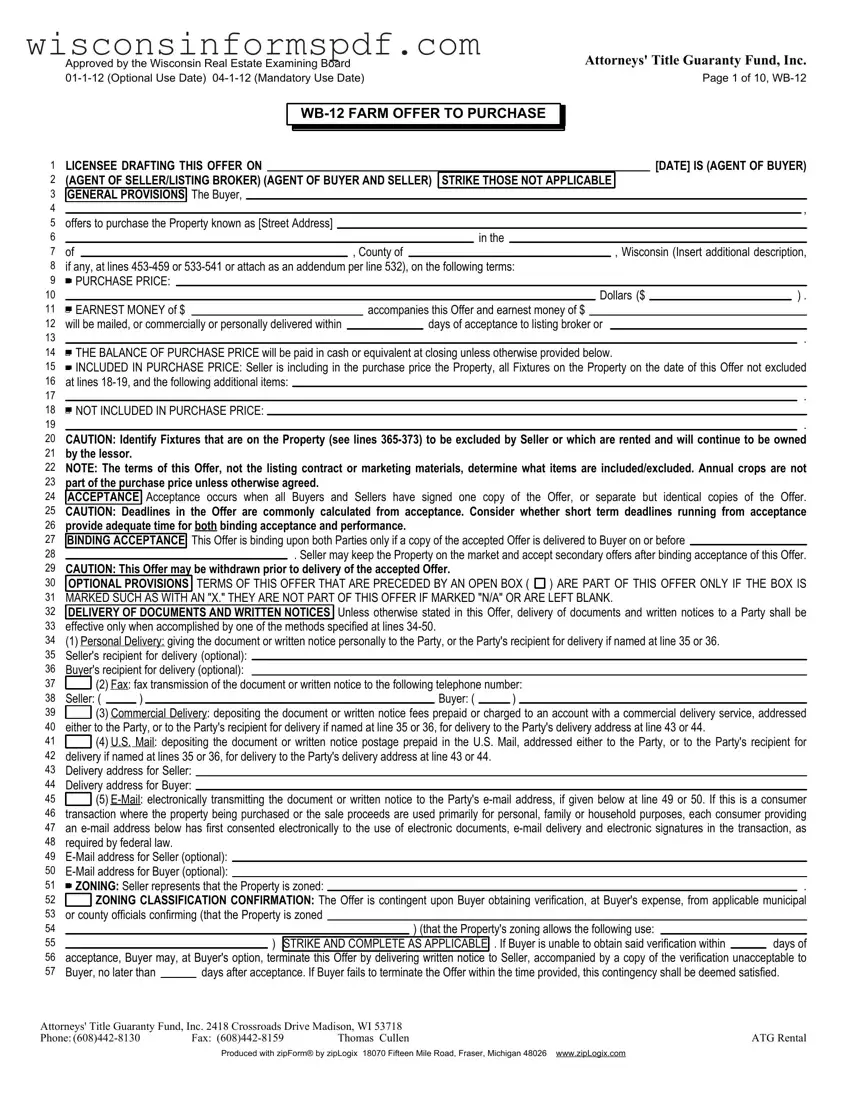
Embarking on the journey to purchase farm property in Wisconsin entails the navigation through a substantial document known as the WB-12 Farm Offer to Purchase form. This form, ratified by the Wisconsin Real Estate Examining Board and the Attorneys' Title Guaranty Fund, Inc., mandates usage for such transactions from April 1, 2012, onwards. It meticulously outlines the terms under which a buyer proposes to acquire farm property, encapsulating vital details such as purchase price, earnest money, property inclusions and exclusions, and distinctive conditions like zoning and property condition representations. Furthermore, it delves into specific contingencies like well water and system inspections, environmental assessments, and private onsite wastewater treatment system inspections, ensuring a thorough examination of the property's condition. Designed to safeguard both parties' interests, it also specifies methods for effective communication, binding acceptance deadlines, and the handling of any discovered defects or legal compliances, including issues related to managed forest land, farmland preservation, and shoreland zoning ordinances. By setting a structured pathway for real estate transactions, the form upholds transparency, legal compliance, and fairness in the negotiation and purchasing process, making it an indispensable tool for engaging in Wisconsin's farm real estate market.
| Fact Name | Description |
|---|---|
| Form Definition | WB-12 Farm Offer to Purchase is a form used in Wisconsin for making an offer to purchase farm property. |
| Governing Law | The form is approved by the Wisconsin Real Estate Examining Board and Attorneys' Title Guaranty Fund, Inc. |
| Usage Dates | Optional Use Date is 01-1-12, and Mandatory Use Date is 04-1-12. |
| Page Details | This form is located on Page 1 of a 10-page document. |
| Agent Representation | The agent drafting the offer must indicate their representation status: agent of buyer, agent of seller/listing broker, or agent of both buyer and seller. |
| Purchase Price and Earnest Money | The form outlines terms for stating the purchase price and handling of earnest money. |
| Acceptance and Binding Agreement | Acceptance occurs when all parties have signed the offer. The offer is binding only if a copy of the accepted offer is delivered to the buyer by a specified deadline. |
| Inclusions and Exclusions | The offer specifies what fixtures and additional items are included in or excluded from the purchase price. |
Filling out the Wisconsin Offer to Purchase form, specifically the WB-12 Farm Offer to Purchase, is a crucial step in the process of buying or selling farmland in Wisconsin. This document requires detailed information about the parties involved, the property being sold, terms of the sale, and other essential data. Approaching this form with attention to detail and accuracy ensures that all parties have a clear understanding of the offer's terms. Below are step-by-parse instructions to guide you through completing this form.
Once you've completed these steps, carefully review the form to ensure all information is accurate and complete. Both the buyer and seller must sign and date the form to indicate their agreement to its terms. Following this, the next steps involve ensuring all contingencies are met, proceeding with inspections, appraisals, and obtaining necessary financing leading up to the closing date where the final exchange of ownership will take place.
What is the purpose of the WB-12 Farm Offer to Purchase form?
The WB-12 Farm Offer to Purchase form is utilized by individuals in Wisconsin to make an official offer to buy a farm property. This document outlines the terms under which the buyer proposes to purchase the property, including the purchase price, earnest money details, and any conditions that must be met for the sale to proceed.
Who approves the WB-12 form, and is its use mandatory?
The Wisconsin Real Estate Examining Board and Attorneys' Title Guaranty Fund, Inc. approve the WB-12 form. Its use became mandatory as of April 1, 2012, providing a standardized format for farm property transactions in Wisconsin.
Can the WB-12 form be withdrawn after it is submitted?
Yes, the offer outlined in the WB-12 form can be withdrawn before the seller delivers an accepted offer to the buyer. It's essential for buyers to understand the stipulations around withdrawing an offer to ensure they follow the correct procedures.
What are some of the key provisions included in the WB-12 form?
The form includes detailed sections on the purchase price, earnest money, balance of the purchase price, items included and not included in the sale, zoning, closing details, responsibilities for property inspections and tests, environmental assessments, and conditions affecting the property. These sections are designed to provide clear expectations and responsibilities for both the buyer and the seller.
How are deadlines calculated according to the WB-12 form?
Deadlines within the WB-12 form are typically calculated by excluding the day the event occurred and counting the following calendar days, with the deadline expiring at midnight on the last day. Specifics regarding the calculation of business days and hours are also outlined to ensure clarity between both parties.
What happens if defects are found after an inspection contingency is fulfilled?
When defects are identified after fulfilling an inspection contingency, the form outlines options for the buyer and seller, including the seller's right to cure the defects. Details on how defects must be addressed and within what timeframe are specified to ensure any issues are resolved satisfvely before closing.
Are there any specific environmental assessments required?
Yes, the WB-12 form includes provisions for environmental site assessments to be conducted by a qualified independent environmental consultant. This assessment identifies material violations of environmental laws and the presence of hazardous substances, ensuring the buyer is aware of any environmental concerns with the property.
What responsibilities does the seller have regarding property condition representations?
Sellers are required to represent the condition of the property to the best of their knowledge, including any known defects or conditions that could affect the transaction. They must provide a Real Estate Condition Report detailing these conditions, which becomes part of the offer, ensuring buyers are fully informed of the property's state before purchasing.
When filling out the Wisconsin Offer to Purchase form, a few common mistakes can lead to delays, misunderstandings, or even the nullification of the agreement. Knowing what these pitfalls are can help individuals navigate the process more efficiently and ensure their transaction proceeds smoothly.
Firstly, one of the most frequent errors involves failing to accurately identify all parties involved in the transaction. It's crucial that the names of the buyer(s) and seller(s) are written clearly and match their legal documents exactly. Any discrepancy in this section can cause significant issues down the line.
Another common mistake lies in the description of the property. Line 6 requires a precise address and additional description if necessary. Often, individuals neglect to provide enough detail or attach the required addendum for a comprehensive property description. This oversight can lead to confusion about exactly what land and fixtures are included in the sale.
Additionally, ignoring the specific conditions and contingencies related to the inspection and environmental assessment of the property, detailed in lines 165-212, is a serious error. These provisions are designed to protect both parties by ensuring the property meets certain standards before proceeding with the sale.
Moreover, a critical area where mistakes are commonly made is in the section detailing prorations and other adjustments at closing. Accurate calculations and clear understanding of responsibilities for taxes, utilities, and other prorated items are essential for a smooth closing process.
To minimize errors and ensure a smooth transaction, it's recommended to consult with a real estate professional or legal advisor familiar with Wisconsin property laws when completing this form.
When preparing or finalizing a real estate transaction in Wisconsin, especially concerning the purchase of farmland as outlined in the Wisconsin Offer to Purchase form, several documents and forms often accompany the main offer. These documents are crucial for the transparent, lawful, and smooth transition of property ownership. Here's a brief overview of these forms and their purposes:
Each of these documents plays a specific role in ensuring the transaction proceeds fairly and legally for all parties involved. They serve to protect the interests of both the buyer and the seller, providing a clear, legally binding outline of the terms of the sale, the condition of the property, and the responsibilities of each party.
The Wisconsin Offer to Purchase Real Estate form shares similarities with several other legal documents, each designed to facilitate different aspects of real estate transactions and property management. Understanding these documents can provide invaluable insight into the complexities of buying, selling, or managing real estate.
One similar document is the Residential Real Estate Purchase Agreement. This form serves a similar fundamental purpose to the Wisconsin Offer to Purchase—initiating the process of buying or selling residential property. Both documents outline the terms of the sale, including purchase price, property details, and closing conditions. However, the specific provisions and legal requirements may vary based on the jurisdiction and type of property involved.
Another related document is the Real Estate Listing Agreement. While the Offer to Purchase is used by buyers to propose buying property, the Listing Agreement is a contract between a property owner and a real estate agent, detailing the terms under which the agent will sell the property. Though one documents the offer and the other the terms of sale representation, both are integral to the transaction process.
The Lease Agreement is another document that, while focused on renting rather than buying property, shares similarities with the Offer to Purchase. Both include specific descriptions of the property, identify the parties involved, and set forth terms regarding the use of the property. Lease Agreements, however, detail occupancy terms rather than ownership transfer terms.
An Amendment to Real Estate Purchase and Sale Agreement is closely related to the Offer to Purchase, as it modifies the terms of an existing purchase agreement. Amendments may be necessary if new information comes to light or if the parties involved mutually decide to alter certain conditions. This flexibility is essential for the fluid nature of real estate negotiations.
Finally, the Property Disclosure Statement, although not a contract, is a document often used in conjunction with the Offer to Purchase. Sellers use it to disclose known issues with the property, which can significantly influence negotiations and the final terms of the purchase agreement. While one is a disclosure and the other a proposal, both are critical for ensuring transparency and honesty during the transaction process.
When filling out the Wisconsin Offer to Purchase form, particularly for transactions involving property, attention to detail and accuracy are paramount. This form, which becomes a legally binding document upon acceptance, requires careful consideration of its stipulations and precise completion. The pointers below highlight key practices to observe (the dos) and pitfalls to avoid (the don'ts) to ensure a smooth transaction.
Do:
Don't:
By adhering to these guidelines, parties involved in a property transaction can navigate the complexities of the Wisconsin Offer to Purchase form more effectively, minimizing risks and facilitating a smoother closing process.
One common misconception is that the "binding acceptance" clause of the Wisconsin Offer to Purchase form implies that the seller cannot accept other offers after a primary offer is accepted. In reality, it means that the offer accepted by both buyer and seller becomes a legally binding agreement. However, the seller can accept backup offers in case the primary offer falls through.
Many believe the earnest money deposit is non-refundable. While earnest money is a sign of the buyer's commitment, it is typically refundable under certain conditions outlined in the contingency clauses of the offer.
There's a misconception that all fixtures and appliances automatically come with the property. According to the form, only fixtures not excluded and additional items explicitly included in the purchase price come with the property. It's crucial for both parties to clearly specify which items are included and which are not.
Some assume the closing date listed is final and unchangeable. However, the actual closing date can often be negotiated and adjusted by mutual agreement of the buyer and seller if necessary conditions arise.
It's mistakenly believed that the offer to purchase form is merely a formality without legal significance. In reality, once signed by both parties, it is a legally binding contract with specific obligations and responsibilities for both the buyer and seller.
Another common misunderstanding is that buyers must accept the property "as is" without the opportunity for inspections. Buyers have the right to request inspections and, depending on the outcomes, negotiate repairs or adjustments to the offer.
There is a misconception that a verbal agreement between the buyer and seller is as binding as the written offer. Legally, real estate transactions must be in writing to be enforceable under the Statute of Frauds.
Some believe that once an offer is made, it cannot be withdrawn. In fact, an offer can be withdrawn any time before it is accepted by the seller, as long as the withdrawal is communicated to the seller or their agent.
Lastly, there's a mistaken belief that the use of this form avoids the need for real estate professionals or legal advisors. While the form is designed to standardize the transaction process, professional advice can provide valuable insights and protect both parties' interests.
Who Does Well Inspections - Designed to be user-friendly, facilitating easy completion by certified well inspectors.
Wisconsin Permit - Insurance verification reminders are explicitly stated as a compliance measure within the MV3001 instructions.