Fill Your Wisconsin Residential Offer Form
Fill Your Wisconsin Residential Offer Form
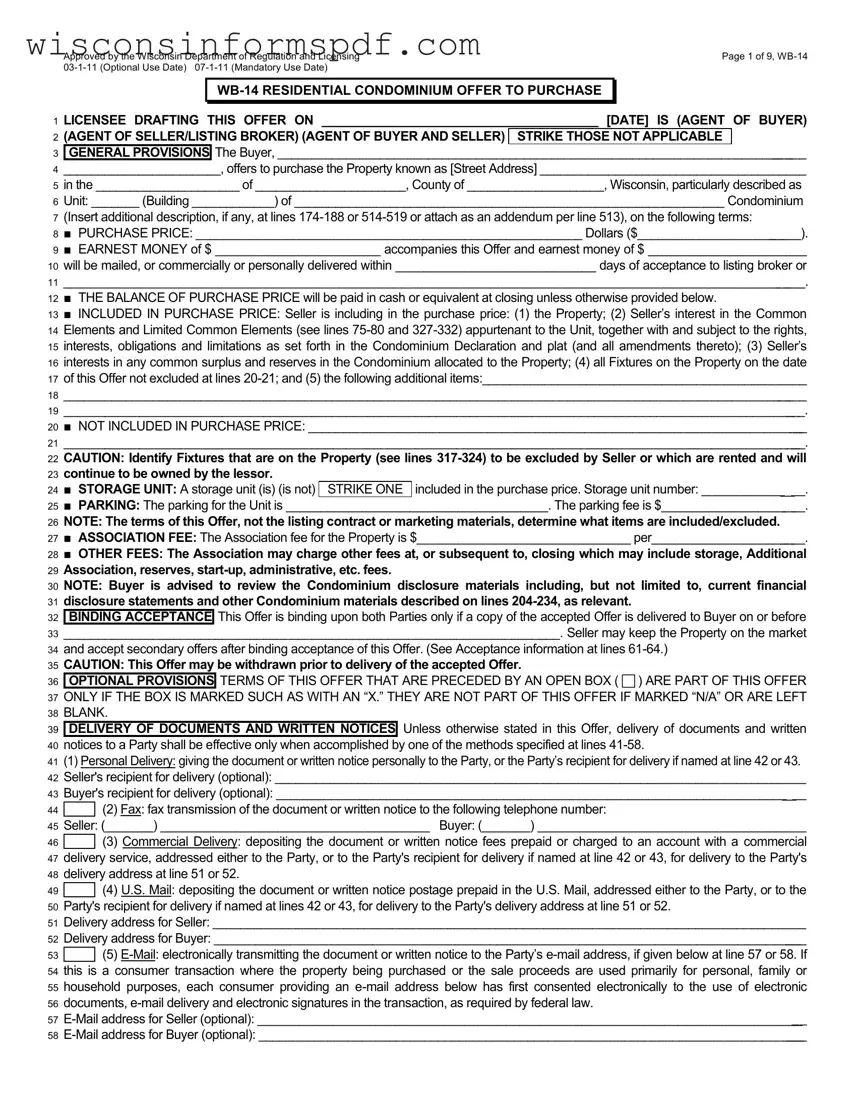
Engaging with the Wisconsin Residential Offer to Purchase form, approved by the Department of Regulation and Licensing, unfolds like navigating through a maze of structured legal formulations, catering specifically to the intricate process of buying a condominium. This mandatory document, set into use from July 1, 2011, encapsulates the earnest intentions of a buyer to embark on the ownership path of a coveted property, laying down the fundamental prerequisites that govern such a transaction. Encompassing a purchase price proposition, earnest money deposits, balance payment strategies at closing, and meticulously listing the components included or excluded from the sale, it serves as a cornerstone for transaction transparency between buyer and seller. A comprehensive review of common and limited common elements, alongside a balance between included fixtures versus those distinctly excluded, ensures clarity. It cautions about personal delivery nuances and emphasizes the looming deadlines that could inadvertently affect the binding acceptance. With a spotlight on association fees, other potential costs, and binding acceptance terms, this form navigates through financing contingencies, appraisal dependencies, and even delves into the intricate details of property condition representations, closing adjustments, and prorations—all aimed at safeguarding the interests of both parties involved. This document not only underscores the obligations and rights fixed on paper but also highlights the regulatory compliance and due diligence incumbent upon the transacting parties, making it an indispensable ally in the quest for residential ownership within Wisconsin's borders.
| Fact | Description |
|---|---|
| Approval Authority | This form is approved by the Wisconsin Department of Regulation and Licensing. |
| Form Number and Version | WB-14 03-1-11. Use is optional from March 1, 2011, and mandatory from July 1, 2011. |
| Form Title | Wisconsin Residential Condominium Offer to Purchase. |
| Purpose | Used for making an offer to purchase a condominium unit in Wisconsin. |
| Agent's Role | The form includes provisions for identifying the agent's relationship, whether they are an agent of the buyer, seller, or both. |
| Governing Law | Governed by Wisconsin Statutes. |
| Inclusions & Exclusions | Specifies what is included or excluded in the purchase, such as fixtures and additional items. |
| Property Description | Provides for a detailed description of the property, including any additional descriptions or addenda attached. |
| Financing and Payment | Addresses earnest money, balance of the purchase price, and financing terms. |
| Occupancy and Closing | Detailed stipulations regarding occupancy terms and closing arrangements, including adjustments, prorations, and notifications. |
Filling out the Wisconsin Residential Offer to Purchase form is a significant step in making an offer on a residential condominium. This document covers all the necessary details, from the offer price to specific conditions, ensuring both the buyer and seller are well-informed about the terms of the offer. Due diligence is essential in accurately completing each section, as this legally binding agreement sets the stage for the transaction process. The following steps will guide you through filling out the form correctly.
Once the Wisconsin Residential Offer to Purchase form is fully completed and both parties have signed, the next steps involve waiting for the offer to be accepted, conducting any required inspections or fulfilling contingencies, and moving towards closing the transaction. Depending on the specifics of the offer, this might include applying for and securing financing, completing a home inspection, or selling another property. Throughout this process, communication between the buyer, seller, and their respective agents is key to successfully navigating towards the closing date.
What documents and notices are considered effectively delivered in the Wisconsin Residential Offer to Purchase context?
Documents and written notices are considered effectively delivered when accomplished through one of the specified methods: personal delivery to the party or the party's designated recipient, fax transmission to the provided telephone number, deposit with a commercial delivery service prepaid or charged to an account for delivery to the specified address, postage prepaid mail addressed for delivery to the party's specified address, or email transmission to the given address, assuming compliance with federal law requirements for electronic transactions in consumer deals.
Does the Wisconsin Residential Offer to Purchase include provisions for financing contingencies?
Yes, the offer includes provisions for financing contingencies. This contingency allows the buyer a specified period to obtain a written mortgage loan commitment under stated conditions. If the buyer is unable to secure financing on those terms and notifies the seller within the prescribed timeframe, the offer can become null and void. Furthermore, terms related to interest rates, types of financing, and responsibilities for loan application and commitment are outlined, including consequences for failure to secure a commitment and options for seller financing if the buyer's financing falls through.
How are real estate taxes handled in the closing of the Wisconsin Residential Offer to Purchase?
Real estate taxes are prorated at closing based on the date of closing values. The proration can be calculated using the net general real estate taxes for the previous year, the current assessment times current mill rate, or other agreed formulas. The prorated taxes account for state tax credits and lottery credits deducted to determine the net general property taxes. Additionally, buyer and seller agree to re-prorate real estate taxes based on the actual tax bill for the year of closing, establishing a post-closing obligation to adjust the prorated amounts accurately.
What are the seller's obligations regarding the Real Estate Condition Report and Condominium disclosure materials?
Sellers are required to furnish buyers with a Real Estate Condition Report, excluding certain transactions, within 10 days after acceptance of the contract of sale. For condominium transactions, the seller must also provide a Condominium Addendum to the Real Estate Condition Report along with the executive summary and other relevant condominium disclosure materials as dictated by Wisconsin statutes. These disclosures must include current and accurate copies of the condominium's declaration, bylaws, rules, budget, leases, and planned or existing expansion, among others. These documents should be delivered within a designated timeframe, offering the buyer a right to rescind the offer upon review.
Filling out a Wisconsin Residential Offer to Purchase form is a critical step in the home-buying process, yet it's common for buyers or their agents to make mistakes. These errors can delay transactions, lead to misunderstandings, or, in worst-case scenarios, result in legal disputes. Understanding the most frequent mistakes can help ensure a smoother transaction.
One of the first and most significant mistakes is incorrectly identifying the parties involved. It's crucial to use full legal names and ensure they match the names on all related documents, including the title and loan paperwork. Misspellings, nicknames, or omitting a middle initial can lead to confusion about the transaction's legitimacy and may require legal amendments later.
Another common error is failing to accurately describe the property. The property's legal description must match the one on the current deed or title. Simply using a street address is not sufficient, as it may not accurately convey the full extent of the property, including any easements, rights of way, or specific condominium unit numbers. Omissions or inaccuracies in this section can result in disputes over what was intended to be included in the sale.
Buyers and agents often miscalculate financial amounts, such as the earnest money deposit, total purchase price, or allocation of closing costs. This not only impacts the validity of the offer but can also affect loan approvals and closing procedures. Ensuring that all financial information is correct and agreed upon in writing protects all parties involved.
The final frequent mistake is overlooking contingency clauses. Contingencies for financing, home inspections, appraisals, or the sale of another property are safeguards for the buyer but must be clearly written and include specific deadlines. Vague or missing contingencies can leave a buyer vulnerable or lead to disputes if the conditions are not met to the satisfaction of all parties.
To avoid these and other errors, thorough review and understanding of each section of the offer form is essential. Professional guidance from a real estate agent or attorney can provide further clarification and ensure that the offer to purchase aligns with the buyer's intentions and legal requirements.
When navigating the process of purchasing residential real estate in Wisconsin, particularly a condominium, various forms and documents beyond the initial Wisconsin Residential Offer to Purchase are typically needed. These additional documents are crucial for a holistic understanding of the property in question, the obligations of the involved parties, and the intricacies of the real estate transaction. Detailing each necessary form and document can provide further insight into the comprehensive steps and requirements of a property purchase in Wisconsin.
These documents collectively ensure that the buyer is fully informed about the property they are intending to purchase and the terms of their offer. They further protect the legal rights and responsibilities of both the buyer and seller throughout the transaction process, ensuring a smooth transfer of ownership. Understanding each document’s purpose and ensuring its accurate completion is essential for a successful real estate transaction in Wisconsin.
The Wisconsin Residential Offer form shares resemblance with the Purchase Agreement forms used in other states, such as the California Residential Purchase Agreement (RPA). Both documents outline the terms of sale for a residential property, including the purchase price, financing arrangements, and any contingencies that must be met for the transaction to go forward. They also detail what is included in the sale, such as fixtures and personal property, and set forth the obligations of the buyer and seller for conducting inspections and disclosing conditions of the property.
Similar to the Uniform Residential Loan Application, the Wisconsin Residential Offer form includes sections that deal with the financing of the purchase, specifying how the purchase will be paid for, whether through cash at closing or a combination of cash and mortgage financing. It outlines the buyer's obligation to secure financing and the conditions under which the buyer or seller can back out of the contract if financing cannot be obtained.
The form is akin to Disclosure Statements, which are mandatory in many real estate transactions across the U.S. This is evident in the sections dedicated to disclosing conditions affecting the property or the transaction, where sellers must disclose known defects and potential buyers are advised to review these disclosures carefully before proceeding. These sections serve to inform the buyer of any known issues with the property, similar to how disclosure statements work to ensure transparency in real estate transactions.
The Condominium Association Documents, another related document type, are mirrored within the Wisconsin Residential Offer form through the inclusion of terms that deal with the buyer's review of condo association bylaws, budgets, and financial health. Buyers are advised to consider these documents before purchasing a condo unit, which parallels the requirement in condo sales to review such association documents for a clear understanding of the conditions attached to the property.
Lease Agreements find their counterpart in the Wisconsin Residential Offer form in sections discussing leased property, where it specifies the transfer of the seller's rights under any lease(s) to the buyer upon closing. This includes the assignment of security deposits and an inventory of remaining lease obligations, ensuring that any tenancies are acknowledged and appropriately managed in the transition of property ownership.
Real Estate Condition Reports closely mirror the Wisconsin Residential Offer form in its function to detail the condition of the property at the time of sale. Both emphasize the importance of truthfully reporting the state of the property to inform the buyer's decision, highlighting necessary repairs or defects that could affect the property's value or safety.
Financing Contingency Clauses within many real estate contracts are also found in the Wisconsin Residential Offer form. These clauses allow the buyer to back out of the purchase if they cannot secure financing within a specified period, thereby protecting the buyer from being locked into a purchase they cannot afford and ensuring the seller is aware of the possibility of the sale not proceeding due to financing issues.
Appraisal Contingencies, commonly part of the home buying process, are incorporated into the Wisconsin Residential Offer form, requiring that the property meets or exceeds the agreed-upon purchase price in an appraisal. This protects the buyer's interests by ensuring they do not overpay for the property based on the lending institution's valuation.
Association Fees and Assessments details in the Wisconsin Residential Offer form closely relate to budget and financial statements typically reviewed by prospective buyers in homeowner and condo association-governed communities. These sections outline the costs associated with living in such communities, including regular assessments and any special fees that might apply, thereby ensuring buyers are fully informed about ongoing costs beyond the purchase price.
Lastly, Mitigation Plans, akin to those required under specific environmental or zoning conditions, are reflected in the Wisconsin Residential Offer form's references to DNR rules and other regulations affecting the property. This ensures that buyers are aware of any additional responsibilities or costs associated with maintaining the property in compliance with local laws and regulations.
When completing the Wisconsin Residential Offer to Purchase form, it's important to ensure that all the information provided is accurate and thoroughly considered. Here are some do's and don'ts to guide you through the process:
When working with the Wisconsin Residential Offer to Purchase form, several misunderstandings commonly arise. Understanding these points can help buyers and sellers navigate the process more effectively:
The offer is only valid once the seller accepts it. People often think that filling out and submitting the form binds them to the transaction. However, it becomes binding only when the seller accepts the offer and communication of that acceptance is delivered back to the buyer.
Verbal agreements are not enforceable. Any changes or agreements not written into the offer form or an attached amendment are not legally enforceable. All terms must be documented within the form or official addendums.
Initial earnest money is not always required. While customary, the offer can be made without accompanying earnest money. The terms regarding earnest money, including any to be paid after acceptance, are negotiable between buyer and seller.
Personal property inclusion must be specific. Simply assuming that certain fixtures or personal property convey with the sale unless specifically excluded can lead to misunderstandings. Items to be included in the sale ought to be listed explicitly in the offer.
Storage and parking details must be clarified. Whether a storage unit or parking is included in the purchase price should be confirmed in the offer. If these elements are essential to the buyer, their inclusion should be stated clearly.
Condominium assessment fees are subject to change. Buyers sometimes assume that current assessment fees won't change. It is essential to understand that these fees can be increased by the association after purchase.
Buyers must conduct their due diligence. The form advises buyers to review the Condominium disclosure materials thoroughly. Relying solely on information provided in listings or by agents without reviewing official documents can lead to missed critical details.
The offer can include contingencies for financing and inspection. Some buyers and sellers are unaware that the offer form can include specific contingencies that must be met for the sale to proceed, such as securing financing or satisfactory inspections.
Sellers can accept backup offers. There’s a misconception that once an offer is accepted, the seller cannot entertain other offers. While ethically they should not accept another offer outright, they can accept backup offers in case the primary deal falls through.
Correcting these misconceptions ensures that both parties have a solid understanding of the process, leading to smoother transactions and fewer disputes.
Filling out the Wisconsin Residential Offer to Purchase form is an important step in buying a home. Here are key takeaways to ensure the process runs smoothly:
Following these guidelines can help avoid common pitfalls and ensure the transaction process is as smooth as possible.
Change Birth Certificate Name - This petition allows for the legal adjustment of birth certificates in Wisconsin, offering a structured format for documenting and requesting changes.
706 Estate Tax Return - Payment and mailing instructions for submitting the completed form to the Wisconsin Department of Revenue are provided.