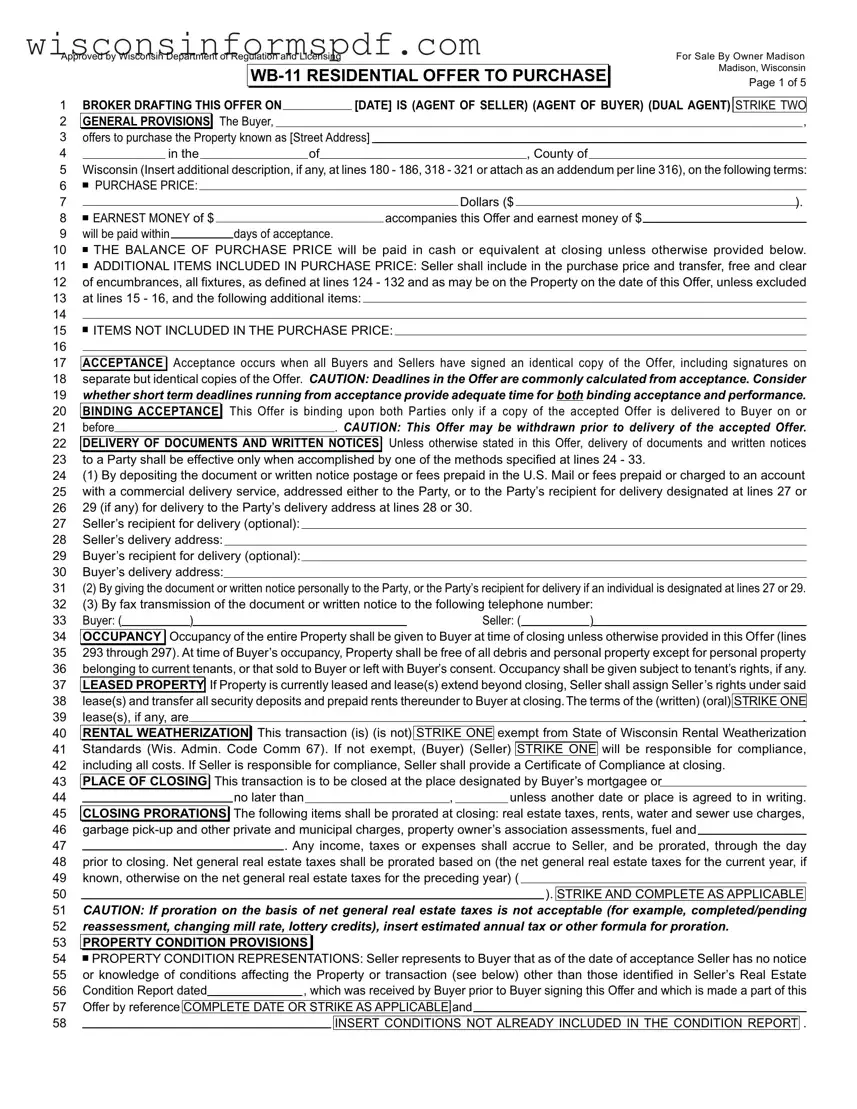
Fill Your Wisconsin Wb11 Form
Fill Your Wisconsin Wb11 Form
In navigating the complexities of real estate transactions within Wisconsin, the WB-11 Residential Offer to Purchase stands out as a fundamental document approved by the Wisconsin Department of Regulation and Licensing. Tailored specifically for sale-by-owner transactions in Madison, this form meticulously outlines the terms under which a buyer proposes to purchase residential property. From specifying the roles of brokers involved to detailing general provisions, purchase price, earnest money agreements, and other key components, the form is comprehensive. It includes stipulations regarding the delivery of documents, occupancy terms, leased property considerations, and conditions surrounding the property itself, among others. The document also covers financial arrangements, including the handling of earnest money, and delineates the obligations and rights concerning property inspections and potential property damage prior to closing. Its provisions concerning property conveyance, title evidence, and special assessments ensure clarity and legal compliance in transactions. Importantly, standard clauses about default, legal remedies, and the finality of the agreement underscore the WB-11 form's role in safeguarding both buyer and seller rights while promoting transparent and fair real estate transactions in Wisconsin.
| Fact Name | Detail |
|---|---|
| Approval Authority | The Wisconsin WB-11 form is approved by the Wisconsin Department of Regulation and Licensing. |
| Purpose | It is used for residential property purchases, specifically for sale by owner transactions in Madison, Wisconsin. |
| Governing Law | The form adheres to the Wisconsin Statutes and Administrative Code applicable to the sale of residential properties, including mandatory disclosures and rules about earnest money disbursements. |
| Key Components | This form includes provisions on purchase price, earnest money, acceptance terms, delivery of documents, property condition representations, and closing arrangements, among others. |
Filling out the Wisconsin WB-11 Residential Offer to Purchase form is a crucial step in the home buying process for those looking to purchase residential property in the state of Wisconsin. This form lays out the terms of the offer, including the purchase price, earnest money deposit amounts, and other conditions of the sale. Completing this form accurately is vital to ensure a smooth transaction and to protect the interests of all parties involved. The following steps are designed to guide you through the process of filling out this form.
Once completed, this form serves as a legally binding document outlining the terms of your offer to purchase residential property. It is recommended that buyers review this document carefully with their real estate agent or attorney to ensure understanding and accuracy before submission.
What is the WB-11 form used for in Wisconsin?
The WB-11 form, known as the Residential Offer to Purchase, is a legal document used in Wisconsin for the sale of residential properties. It outlines the terms and conditions under which a buyer proposes to purchase a residential property from a seller. The form is approved by the Wisconsin Department of Regulation and Licensing and facilitates clear communication of the offer details between all parties involved.
Who needs to sign the WB-11 form?
Both the buyer and the seller need to sign the WB-11 form for it to be considered a valid and binding agreement. Signatures from all legally responsible parties on both the buying and selling sides are necessary to ensure the enforceability of the offer. Additionally, the form may be presented to the seller by a representative, such as a real estate agent, who also acknowledges receipt and involvement in the offer's presentation.
Is earnest money required when submitting a WB-11 form?
Yes, earnest money is typically required to accompany the WB-11 form. Earnest money is a deposit made by the buyer to demonstrate their good faith and seriousness about proceeding with the purchase. The amount of earnest money and the terms regarding its payment and potential refundability should be clearly stated in the offer.
What happens if the Property is damaged before closing?
If the Property is damaged before closing, the seller is obligated to repair the Property and restore it to the condition it was in on the day of the offer, provided the damage does not exceed five percent (5%) of the selling price. If the damage exceeds this amount, the buyer has the option to cancel the offer or proceed with the purchase and receive a credit toward the purchase price equal to the amount of the seller’s deductible, along with any applicable insurance proceeds.
Can a buyer withdraw their offer?
A buyer can withdraw their offer before it is accepted by the seller. However, once both parties have signed the WB-11 form and the offer is delivered to the buyer indicating acceptance, it becomes a legally binding contract. Withdrawal at that point would subject the buyer to potential legal and financial consequences unless stipulated otherwise by contingencies within the offer.
What are a buyer’s inspection rights according to the WB-11 form?
According to the WB-11 form, the buyer has the right to conduct inspections of the Property to satisfy any contingencies listed in the offer. The seller agrees to provide reasonable access to the Property for these inspections, which may include a general home inspection or specific tests as detailed in the agreement. The buyer is responsible for the cost of inspections and must promptly share results with the seller. Any findings must be addressed in accordance with the terms specified in the offer, including any rights the seller has to cure identified defects.
When completing the Wisconsin WB-11 Residential Offer to Purchase form, several common errors can impact the transaction process significantly. One notable mistake is the incorrect or incomplete listing of items included or excluded from the purchase price in Sections 11 and 15. This can lead to misunderstandings regarding which fixtures, appliances, or other personal properties are part of the sale. It's important for both parties to clearly specify these items to avoid any disputes or confusion at closing.
Another critical area often filled out incorrectly is the financing contingency provisions found in Sections 149 to 168. Buyers sometimes fail to accurately detail the financing terms or misunderstand the implications of the contingency itself. An accurate description of the loan type, source, amount, and terms is crucial. It ensures that the buyer is protected by the contingency clause if financing cannot be secured under the stated conditions. Additionally, specifying the deadline for securing financing is essential, as failure to meet this deadline can jeopardize the purchase.
Additionally, failing to thoroughly review and address special assessments and property condition provisions can lead to unexpected costs and obligations after closing. Special assessments (Sections 213-216) may require the buyer or seller to cover significant expenses, while the property condition provisions (Sections 54-58) necessitate a detailed review of any known issues with the property. These sections are designed to protect the parties but must be carefully completed to ensure that protection.
Addressing these common errors when filling out the Wisconsin WB-11 form can help ensure a smoother transaction process, reducing the risk of delays, disputes, and additional costs.
The process of buying or selling a property in Wisconsin is comprehensive and involves various steps and documentation beyond the initial Wisconsin WB-11 Residential Offer to Purchase form. Understanding the ancillary documents often used in conjunction with the WB-11 form is crucial for a smooth transaction. These documents each serve their unique purpose, from disclosing the condition of the property to ensuring the title is clear. Here's a brief rundown of some other forms and documents commonly used in Wisconsin real estate transactions.
Each of these documents plays a specific role in ensuring that both buyers and sellers are well-informed and protected throughout the property transaction process. Armed with the right information and documentation, participants in a real estate transaction can navigate the complexities with confidence, knowing that their interests and investment are safeguarded. It's always advisable to consult with a real estate professional or attorney when dealing with these documents to ensure they are completed accurately and effectively.
The Wisconsin WB-11 Residential Offer to Purchase is similar to other purchase agreements across the United States, such as the California Residential Purchase Agreement (RPA). Both types of contracts establish the terms and conditions under which a residential property will be sold, including purchase price, financing terms, and contingencies that must be met for the sale to proceed. Both agreements aim to protect the rights and outline the responsibilities of both the buyer and the seller throughout the transaction process.
Similar to the WB-11 form, the Florida "As Is" Residential Contract For Sale And Purchase specifically allows buyers to inspect the property and accept it in its current condition, thus highlighting the property's "as is" status. This is akin to the provisions in the WB-11 form where inspections and the state of the property's condition are significant to the transaction. Both documents put emphasis on the buyer's right to inspect and the seller's obligations regarding the property's condition.
The Texas One to Four Family Residential Contract (Resale) shares common features with Wisconsin's WB-11 form, such as detailed financing terms and various contingency clauses. Both documents meticulously outline the responsibilities of each party regarding property condition disclosures, earnest money handling, and specific parameters for financing the property purchase, ensuring transparency and mutual understanding in the residential property transaction.
Similarly, the New York Residential Contract of Sale puts a strong emphasis on property condition disclosures, just as the WB-11 form does. Both contracts require the seller to disclose known defects and may include provisions for the buyer's right to inspect the property. These documents guide the transaction process by ensuring that buyers are well-informed about the property's condition before finalizing the purchase.
The Pennsylvania Agreement of Sale for Residential Property also aligns with the WB-11 by detailing the terms of the property transaction, including parties' identification, property description, purchase price, and financial arrangements. Both documents serve to outline the complete agreement between buyers and sellers, ensuring that all parties are aware of their commitments and the details of the property in question.
The Arizona Residential Resale Real Estate Purchase Contract is another document that echoes the structure and content of Wisconsin's WB-11 form, including stipulations regarding the escrow process, closing costs, and property disclosures. Each contract is designed to mitigate misunderstandrents and disputes by clearly defining the transaction's terms, conditions, and procedural steps.
Similar to the Wisconsin form, the Illinois Residential Real Estate Purchase Agreement includes comprehensive details on the financing contingency, allowing the deal to be nullified if financing is not secured. Both contracts highlight the importance of financial arrangements in the completion of real estate transactions and protect both parties' interests by including specific contingencies related to obtaining financing.
The Michigan Residential Real Estate Purchase Agreement, like the WB-11, includes provisions that allow for earnest money to be held in escrow as a sign of the buyer's sincere intention to complete the purchase. Both documents stipulate how earnest money should be handled, including conditions under which it may be returned to the buyer or forfeited to the seller.
The Ohio Residential Property Disclosure Form, while not a purchase agreement itself, complements forms like the WB-11 by requiring sellers to disclose known material defects of the property. This ensures that the buyer is well-informed about the property's condition, highlighting the importance of transparency and honesty in residential real estate transactions.
Lastly, the Nevada Residential Purchase Agreement shares similarities with the WB-11 in areas such as closing and possession provisions, detailing when and how the transfer of property will occur and any conditions that must be met before this handover. Both agreements aim to clearly set forth expectations regarding the timeline and process of closing to facilitate a smooth transition from seller to buyer.
When engaging with the Wisconsin WB-11 Residential Offer to Purchase form, it's crucial to approach the process with diligence and precision. To guide you, here's a list of things you should do and avoid in order to ensure a smooth operation:
Do:
Don't:
Many people, whether first-time homebuyers or seasoned investors, encounter misconceptions about Wisconsin's WB-11 Residential Offer to Purchase form. It’s important to clear up these misunderstandings to ensure smooth real estate transactions. Here are five common misconceptions:
Understanding these facts about the WB-11 form can help buyers, sellers, and their agents navigate the complexities of real estate transactions in Wisconsin more smoothly. It underscores the importance of working with knowledgeable professionals who are up to date with the state's current real estate laws and practices.
Filling out and using the Wisconsin WB-11 Residential Offer to Purchase form is a significant step in the home buying and selling process. Here are seven key takeaways intended to provide clarity and direction for those navigating this important form:
This form is a comprehensive tool designed to protect all parties involved by clearly laying out the terms of the sale and the conditions that must be met for the transaction to proceed. Properly completed, it facilitates a smoother transition towards closing. Hence, understanding these key takeaways helps both buyers and sellers navigate the complexities of the real estate transaction with more confidence and clarity.
Employment Verification Form Wisconsin - The Wisconsin Verification form is essential for businesses to certify their tax status to the Wisconsin Department of Revenue.
Wisconsin F 10138 - The signature section underscores the applicant's understanding of their responsibilities and agreement with the program's terms.